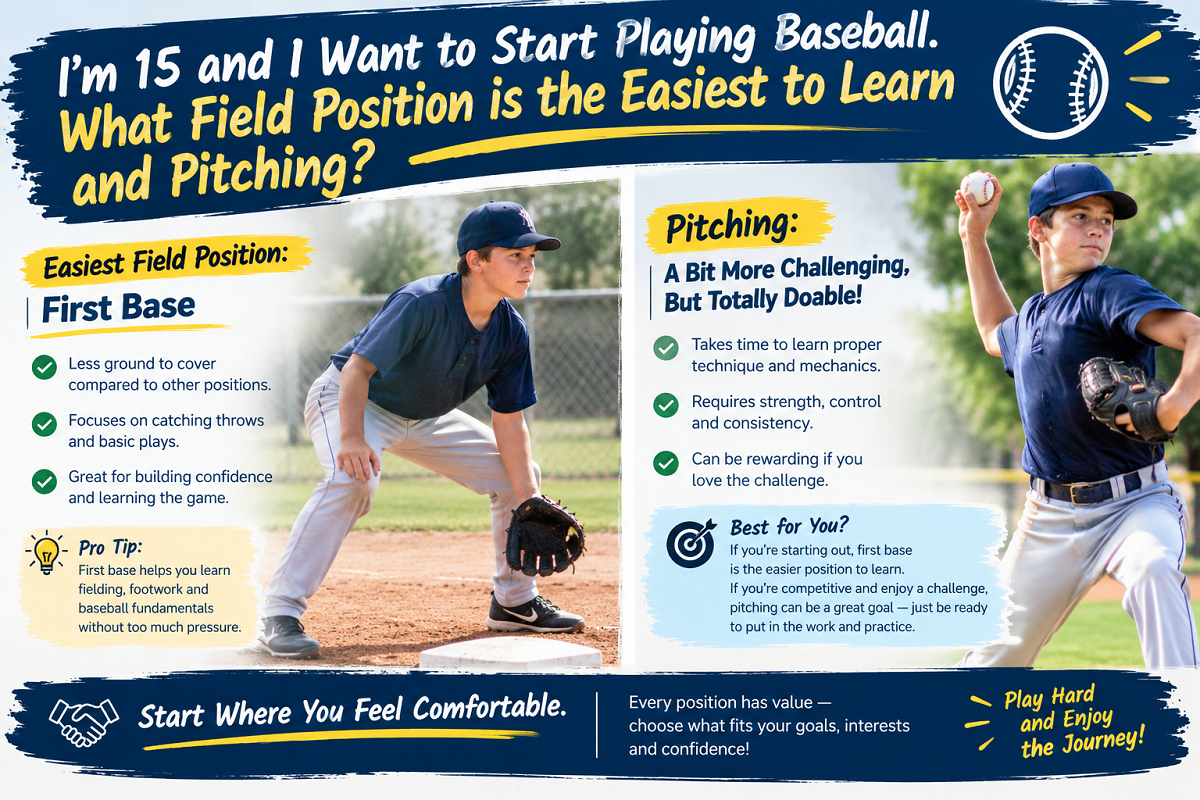
For most 15-year-old beginners, the easiest baseball positions to learn are left field and first base. Right field comes next if you can throw accurately. Pitching is easy to start but the slowest position to master, so most beginners should learn it alongside an easier position instead of one.
That is the answer most pages stop at. The problem is that every beginner has a different weak spot. A player who is afraid of the ball needs a different first position than a player who throws well but runs slowly. Use the table below to find your starting point by your biggest problem, not by a generic ranking.
| If your biggest problem is | Start here | Avoid for now | Why |
| Slow running speed | First base, left field | Center field, second base | First base needs footwork, not range |
| Weak or inaccurate arm | First base, left field | Right field, third base, shortstop | Short or rare throws |
| Fear of getting hit by the ball | Outfield | Third base, catcher | Fly balls arrive slowly and you can see them coming |
| Poor catching or hand-eye coordination | Left field | Second base, shortstop | Fly balls are one steady skill to repeat |
| Left-handed throw | First base, outfield, pitcher | Second base, third base, shortstop | The throwing angle is awkward on the left side of the infield |
| Strong arm but no other skills yet | Right field, then pitcher | Catcher | The arm gets used without needing quick decisions |
| No idea and no preference | First base | Catcher, shortstop | The job is simple and you touch the ball often |
A list that says left field is a 3 out of 10 and shortstop is a 9 treats all beginners the same. In practice, a fast player with a shaky arm will find center field easier than third base, and a tall player with slow feet will find first base easier than anything else. Rankings are a starting guess. Your weak spot is the better guide.
Coaches rarely place beginners by difficulty. They place them where a mistake costs the least while the player learns. That is why new players are often sent to left field or first base. A missed fly ball in left usually costs a base, while a missed ground ball at shortstop can cost a run. Knowing this helps you understand why you may be placed there and why it is not an insult.
Baseball positions have numbers from 1 to 9, and you will hear them in scorebooks, broadcasts and coach talk. Learn them early, because a number like 6-4-3 sounds like code until you know it means shortstop to second base to first base.
| Number | Position | Short form | Main job in plain words | What stresses beginners most |
| 1 | Pitcher | P | Throw strikes, field bunts, cover first | Walking batters, being the center of attention |
| 2 | Catcher | C | Receive pitches, block balls, run the defense | Gear, blocking in the dirt, foul tips |
| 3 | First base | 1B | Catch throws, hold runners, cover the bag | Low throws in the dirt |
| 4 | Second base | 2B | Turn double plays, cover the bag on steals | Footwork on the pivot |
| 5 | Third base | 3B | Field hard grounders, make a long throw | Reaction time |
| 6 | Shortstop | SS | Cover the hole, lead the infield | Range and decisions |
| 7 | Left field | LF | Catch fly balls, throw to the infield | Reading the ball off the bat |
| 8 | Center field | CF | Cover the most ground, call off others | Judging deep balls |
| 9 | Right field | RF | Catch fly balls, throw to third base | The long throw |
A ground ball to the shortstop that he throws to first base is scored 6-3. A double play from shortstop to second to first is 6-4-3. A fly ball caught in center field is F8. Once you can read these, you can follow a scorebook, and you will understand which players are involved in each play.
This confuses many new players. Left field is on your left when you stand at home plate facing the pitcher. It is not the left side from the outfielder's point of view as he faces the plate. Right field is on your right from home plate. If you stand in the outfield and face home plate, the sides flip, so coaches say it as seen from the plate.
Instead of guessing, test yourself. The six checks below need a ball, a partner, a bucket and a tape measure. Write down your results and repeat the test every four weeks. The pass marks are rules of thumb for beginners, not official standards, but they give you a fair picture of where you stand.
| Test | What it measures | How to do it | Rule-of-thumb pass mark | Position it supports |
| 1. Target throw | Accuracy | 20 throws from 60 feet at a bucket-sized target on a wall | 12 or more of 20 land inside the target area | Pitcher, first base, right field |
| 2. Long throw | Arm strength | 5 throws from 120 feet to a partner, one bounce allowed | 3 of 5 reach the partner without a wide miss | Right field, third base |
| 3. Fly ball read | Tracking | Partner throws 10 high arcs to random spots about 60 feet away | 7 or more clean catches | Left field, center field |
| 4. Ground ball | Hands and reaction | Partner rolls or bounces 10 tennis balls from 30 feet | 7 or more clean fields | Second base, third base |
| 5. 60-yard run | Speed | Time a straight run with a phone stopwatch | Under about 8.5 seconds | Center field, second base |
| 6. Flinch check | Comfort with the ball | Partner tosses 10 tennis balls at your chest from 20 feet | Catch or block 8 without turning away | Third base, catcher |
If you pass test 3 and fail the rest, start in left field. If you pass test 1 and test 2, right field or pitcher is a realistic target. If you fail test 6, spend two weeks on soft-ball drills before you take any position that faces hard-hit balls. If you pass nothing yet, that is normal. Start at first base and build the skills one test at a time.
Two beginners can start from very different places. The tests show you which skill is behind and what to train. A player who scores 4 of 10 on ground balls and 9 of 10 on fly balls has a clear plan: play outfield now and practice grounders three times a week.
Use the same distances and write the score down. When a test goes from 5 to 8 out of 10, you have real proof that you are improving, and it also gives you something concrete to tell a coach.
Most guides rank positions by feel. This ranking is built on a different question: what will a brand-new player really do on a typical play, and what hidden job will they forget? Beginner order, easiest first: left field, first base, right field, second base, center field, third base, pitcher, shortstop, catcher.
| Position | How often you touch the ball | What you do on most plays | Hidden job beginners forget |
| Left field | Low | Watch the batter, move on contact, field singles | Back up third base and the cutoff throw |
| First base | High | Catch throws, tag the bag | Hold the runner, then get back to the bag |
| Right field | Low | Field singles and fly balls | Back up first base on infield grounders with the bases empty |
| Second base | Medium | Field grounders, cover the bag | Cover first on a bunt, turn on the double play |
| Center field | Medium | Cover deep balls, call for catches | Back up left and right on every ball |
| Third base | Medium to high | Field hard grounders, long throws | Guard the line, cover third on a steal |
| Pitcher | Every pitch | Throw strikes and field the position | Cover first, back up bases |
| Shortstop | High | Field range plays, make long throws | Lead the infield, cover second |
| Catcher | Every pitch | Receive, block, throw | Call the defense, handle every play at the plate |
Left field can feel like waiting. Then a line drive arrives in the gap. The beginner skill that matters most is the first step: take it back, not forward, when you are unsure. A ball hit over your head scores runs, a ball in front of you usually does not. Learn to throw to the cutoff man instead of trying to throw all the way home.
First base is the best answer when you want to learn by touching the ball often. Your three learning steps are: put your foot on the bag, stretch toward the throw with your other foot, and catch with your glove, not your body. A scoop for low throws comes later. Because infielders keep throwing at you, you get more repetition at first base than almost anywhere else, and repetition is how beginners improve.
Right field is quiet until a runner tries to score from second on a single. Then your throw matters. If your accuracy from test 1 and your long throw from test 2 are decent, right field is a strong choice. If not, work on it for a month before you accept it.
Third base, shortstop and catcher are the positions where bad habits become expensive. A coach or an experienced teammate who can correct your footwork, glove position and throwing angle saves you months of trial and error. If you want one of these three, tell your coach early and ask for extra reps at practice.
Pitcher sits between third base and shortstop on this list. The motion is learnable, but throwing strikes under pressure and protecting your arm make it a longer project than it looks. The next two sections cover it in depth.
You can start pitching at 15, and many players do. The honest version is that pitching has three separate difficulty levels, and beginners usually only learn about them one at a time, the hard way.
Knowing these levels helps you set the right goal. Your first goal is level 1. Do not judge yourself by level 3 in your first month.
A player who starts pitching at 15 can reach a useful level of control and a playable fastball within a season or two with steady work. What a late start changes is the speed race. Players who began throwing at 8 or 9 have years of arm conditioning behind them. If you try to match their speed in your first three months, you raise your injury risk and lose the control that would actually help you. Spend your first season on strikes, mechanics and conditioning, and let speed come as a result.
Most beginners track speed, if they track anything. These four numbers tell you more, and you can measure them with a notebook and a friend.
| Number | How to calculate it | Beginner target after about 3 months | Why it matters |
| Strike percentage | Strikes divided by total pitches | Around 55 to 60 percent | Control comes before speed |
| First-pitch strike rate | First-pitch strikes divided by batters faced | Around 50 to 55 percent | Getting ahead changes the whole at-bat |
| Walks per inning | Walks divided by innings pitched | Under 1 | Free bases score runs |
| Pitches per out | Total pitches divided by outs | Under 6 | Lower numbers mean you protect your arm and stay in the game |
These targets are practical guides for beginners, not official standards. Use them to compare yourself to your own past results.
Draw a strike zone on a wall or a net and divide it into nine boxes. Call a box before each throw, such as low and away, and try to hit it. Track how many of 20 throws go in the called box and how many land anywhere in the zone. This builds command and gives you a measurable improvement without a radar gun.
A pitcher is a fielder after every pitch. Practice three plays until they are automatic: fielding a bunt and throwing to first, covering first on a ground ball to the right side, and backing up a base on an overthrow. Teams lose games because a pitcher freezes on these plays. Ten minutes of practice twice a week fixes that.
This is rarely discussed. If you pitch, your second position matters for your arm. Positions with lots of long throws, such as shortstop, third base and catcher, add arm stress. First base, left field and second base add less. For a new pitcher, first base or left field is a smart pairing because you stay in the lineup without adding heavy throwing.
This plan is a conservative starting template, not medical advice. It assumes you are healthy, have no arm injury history, and warm up before every session. If you have had any elbow or shoulder pain, see a doctor before you begin and ask a coach to adjust the plan.
| Weeks | Focus | Distance | Throws per session | Sessions per week |
| 1 to 2 | Balance, arm path, towel drill, knee throws | 40 feet | 15 to 20 | 2 |
| 3 to 4 | Stride, landing, finish | 45 to 50 feet | 20 to 25 | 2 |
| 5 to 6 | Four-seam grip, aiming at a target | 50 to 55 feet | 25 to 30 | 2 |
| 7 to 8 | Full distance on flat ground, about 70 percent effort | 60 feet 6 inches | 30 | 2 |
| 9 to 10 | Add a changeup for about 10 of the throws | 60 feet 6 inches | 30 to 35 | 2 |
| 11 to 12 | Game-like work: 15-pitch mock innings with fielding | 60 feet 6 inches | 35 to 40 | 2 |
Use the days between sessions for fielding practice, leg work, core work and shoulder band exercises. A strong lower half drives your throw and takes load off your arm. Keep the throwing light and short on these days.
At the end of week 12, repeat the pitcher's scorecard from the earlier section. If your strike percentage is around 55 to 60 percent and your walks per inning have dropped, you are ready to try pitching in a scrimmage. If not, repeat weeks 9 to 12. There is no prize for finishing the plan faster.
Many teens grow quickly at 14 to 16, and a growth spurt can make your timing feel off for weeks. Arms and legs lengthen faster than coordination adjusts. If your control suddenly gets worse and you have grown recently, lower the workload for a week and work on balance drills. It is normal and usually passes.
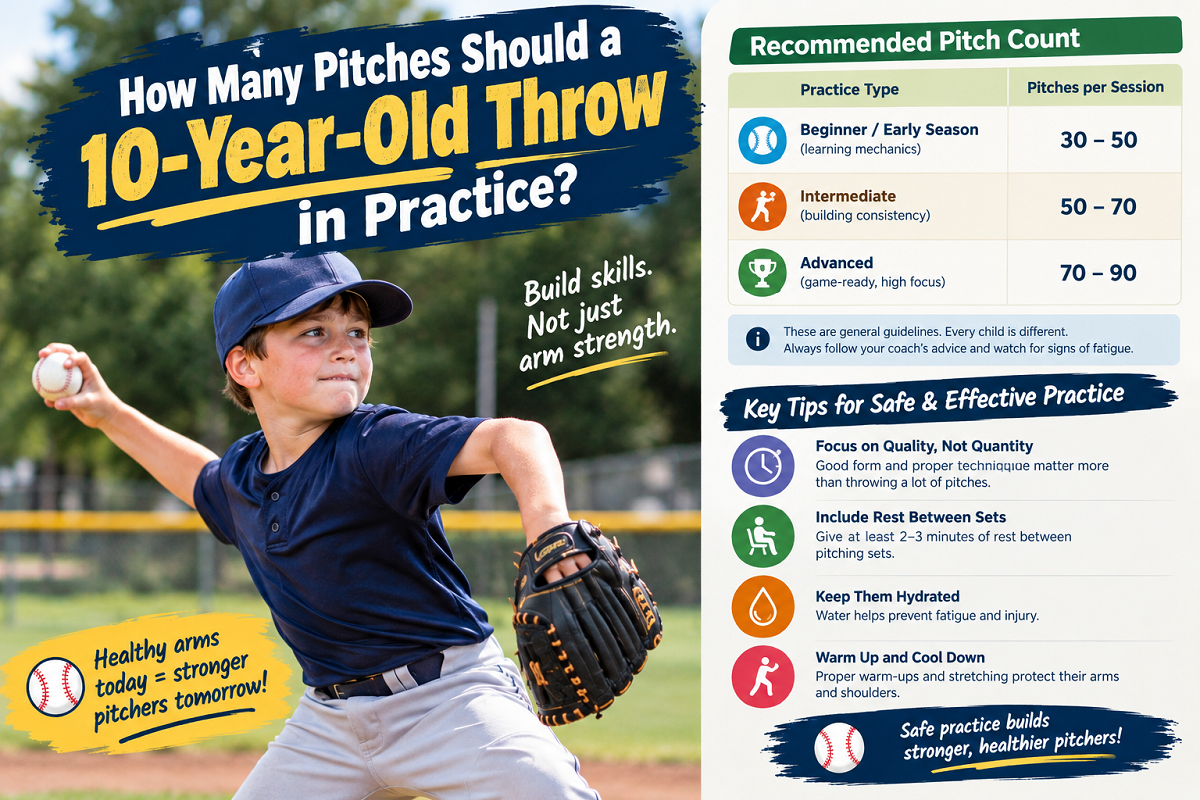
Pitch Smart, a program from Major League Baseball and USA Baseball developed with medical experts, publishes guidelines to protect young arms. For ages 15 and 16 it recommends a daily maximum of 95 pitches, with rest days based on how many pitches you threw. Your league may have different rules, so check them first.
| Pitches in a day | Recommended rest, ages 15 to 16 |
| 1 to 30 | 0 days |
| 31 to 45 | 1 day |
| 46 to 60 | 2 days |
| 61 to 75 | 3 days |
| 76 or more | 4 days |
Pitch Smart advises that a pitcher who throws a large number of pitches in a game, more than about 40, should not play catcher for the rest of that day. Both jobs involve heavy throwing, and combining them raises overuse risk. If you plan to do both, talk to your coach about the limits.
The same guidance recommends giving your arm time off from overhead throwing during the year and not pitching competitively for more than about eight months in any twelve-month period. Avoid pitching for two teams at the same time, and avoid showcases or tournaments that make you throw on many days in a row.
Stop throwing and tell a coach or parent if you feel sharp pain in the elbow or shoulder, pain that lasts into the next day, tingling or numbness in your fingers, or a sudden drop in velocity along with soreness. Normal muscle soreness feels different from joint pain, and if you are not sure, rest and ask a doctor.
Many beginners at 15 already play another sport, and most baseball guides ignore that. Your background can shorten the learning curve if you know which skills carry over and which habits you must change.
| Your background | What carries over | What you must unlearn | Best first position |
| Cricket fielder | Overarm throwing, tracking high catches, diving fielding | Catching with bare hands; baseball needs glove technique | Outfield, first base |
| Cricket wicketkeeper | Quick hands, footwork, reading the ball | A catcher squats, blocks balls in the dirt and throws from a crouch | First base, second base, then catcher |
| Cricket fast bowler | Strong shoulder and core, running momentum | Cricket bowling keeps the arm straight, while pitching uses a bent elbow and more body rotation | Right field, then pitcher with a coach |
| Cricket batter | Eye on the ball, timing | A round bat, a different stance and no bounce before the ball arrives | Any position, work on hitting separately |
| Softball player | Fielding, hitting basics | Overhand throwing from a longer distance, a smaller ball | Infield |
| Tennis or badminton player | Hand-eye coordination, footwork | Throwing mechanics | Outfield, second base |
| Soccer player | Speed, stamina, footwork | Throwing and catching with the hands | Center field, second base |
| Basketball player | Reflexes, height, jumping | Throwing from a long distance | First base, outfield |
| Football quarterback or javelin thrower | A powerful arm | A longer stride and a lower release | Right field, pitcher |
Bowling and pitching both load the shoulder and elbow in different ways. If you still bowl in matches, add pitching slowly and count your total throwing days each week. Do not treat bowling overs as free rest days for your pitching arm.
If you come from a bare-hand sport, you will be tempted to catch with your fingers pointing up and your body behind the ball. Baseball catching uses the glove as the main tool, with the throwing hand ready to close and transfer the ball. Practice receiving 50 throws a day with the glove and the other hand out of the way until it feels natural.
Most high school and club tryouts follow a similar pattern, though each program differs. Knowing the stations helps you stay calm.
| Station | What coaches watch | Beginner tip |
| 60-yard dash | Raw speed and effort | Run through the line, do not slow down early |
| Throwing | Arm strength and accuracy | Accuracy first, use a crow hop and a full finish |
| Ground balls | Footwork, glove position, clean transfers | Get your body in front of the ball, glove low |
| Fly balls | First step and route | Drop step back when you are unsure |
| Batting practice | Swing path and contact | Focus on contact, not power |
| Pitching or bullpen | Strikes, repeatable motion | Throw to the target, not at maximum speed |
Hustle between stations, calling for fly balls, listening carefully, and helping teammates pick up equipment all send a message. A coach with ten beginners and four spots will often choose the player who looks coachable over the player who looks talented but careless.
A short sentence works best: I am new to baseball, I am willing to play anywhere, and I am working on first base and my throwing. It tells the coach you are honest, flexible and already training. If you do not make the team, ask what to improve and join a recreational or club team to keep playing.
Nearly every new player has a rough first month. You will drop easy balls, throw into the dirt and feel embarrassed in front of teammates who have played for years. This is normal and not a sign that you should quit.
Write one line after each practice: what went well, what to fix. Looking back after four weeks shows progress you cannot feel day to day.
Many beginners are scared of getting hit and never say so. This fear slows learning because it makes you flinch and turn away. Use a slow progression: begin with tennis balls tossed underhand from 15 feet, move to reduced-impact baseballs, then to regular baseballs at short distance, and finally to normal speed. Wear your glove and keep your eyes open. Most players lose the flinch within a few weeks when the progression stays slow and calm.
Watch a game and follow one position for a full inning. Notice where the player stands, when he moves and where he throws. Doing this for ten innings teaches you more about positioning than reading a textbook.
A result goal is, make the team. A process goal is, throw 50 accurate throws five days a week. You control the second type, and it leads to the first.
Left field and first base are the easiest for most teenage beginners. Left field has fewer chances and simple fly balls. First base gives you more repetition with a simple job. Use the fit check to confirm which one suits you.
No. Many players begin pitching in their teens. It is late if your goal is to match the speed of players who started at 8 or 9, but it is not late for control and a solid fastball. Focus on strikes, mechanics and a safe workload.
This varies, but a rough guide is about three months of steady work to throw strikes in practice, and six to twelve months before you feel comfortable in games. Your age, coaching, and how often you practice change the timeline. Treat these as estimates, not promises.
First base and left field. First base needs footwork and reach, not range. Left field can work if you read the ball well and take good first steps. Avoid center field and second base until your speed improves.
First base or left field. Both need fewer long throws. Work on your throwing three days a week, and test again every four weeks. Right field, third base and shortstop need a stronger arm.
Second base, left field and center field suit shorter players well, because quick hands and speed matter more than reach. Height helps at first base, but shorter players still play it successfully with good footwork.
First base, outfield and pitcher are the best choices. Left-handed throwers rarely play second base, third base or shortstop because the throwing angle makes some plays slower, though it is not impossible. Catcher is also rare for lefties.
Start in the outfield, where fly balls arrive slowly and you can see them coming. Work through the slow ball progression in the first-month section before you try third base or catcher.
A left-handed thrower wears the glove on the right hand, so buy a glove labeled for a left-hand throw. Check this before you buy, because the labels confuse many first-time buyers.
Pitch Smart guidelines recommend a daily maximum of 95 pitches for ages 15 and 16, with 0 to 4 rest days depending on how many you threw. Your league may have stricter limits, so follow the league rules first.
It is possible, but Pitch Smart advises that a pitcher who throws more than about 40 pitches should not catch later the same day. Both jobs are heavy on the throwing arm, so talk to your coach about limits.
For most beginners, yes in terms of repetition, because you touch the ball more and learn faster. The outfield is easier in terms of fewer chances and less pressure. Choose first base to learn faster and left field to feel safe.
Speed varies a lot, and many 15-year-olds throw in the 60s to low 70s mph. A beginner who throws in the 50s with good control is in a normal place to start. Speed is the last thing to chase.
Yes, you can build most of the basic skills alone or with a friend: wall throws, tee hitting, fly ball and ground ball drills, and the six-test fit check. You still need live games to learn situations, so look for a recreational league, a club or open practice sessions as soon as you can.
Usually left field, right field or first base, because mistakes there cost the least while you learn. Tell your coach you want to try other positions later and show him your progress with your test scores.

This post has been authored and published by one of our premium contributors, who are experts in their fields. They bring high-quality, well-researched content that adds significant value to our platform.