Most advice about baseball tryout nerves boils down to 'tell them to relax and have fun.' Any parent who has tried that knows how it lands. A nervous eleven-year-old can't relax on command, and 'have fun' sounds like a joke when a coach is holding a clipboard.
This guide takes a different route. It pulls together findings from youth sport psychology, research on childhood anxiety, studies of what young athletes say they want from their parents, and research on how families cope when a child is cut. It also tells you where the evidence is strong, where it comes from other sports or adults, and where it is thin, so you can judge the advice for yourself. Where it offers a script, the script is built on those findings.
One caution up front: most of the research below comes from sports other than baseball, and some of it from adults. Baseball has features of its own (one player in the spotlight at a time, a sport where failing most of the time is normal), so treat the research as a guide to principles rather than a guarantee.
A recent study of adolescent athletes found that pressure from coaches predicted both mental worry and physical symptoms of anxiety, and that pressure from parents had its own direct link to physical anxiety (the racing heart, tight muscles and nausea kids describe as 'butterflies' or a sick stomach). The study was done in water polo, so it isn't baseball evidence, but it fits the pattern. See the ScienceDirect paper and a plain-language summary. That matters because a child who gets a stomachache before every tryout may not be exaggerating or avoiding. Their body is responding to the stakes they feel.
Clinical psychologist Kevin Chapman, speaking for TrueSport, argues that parents are among the main sources of anxiety for young athletes because kids pick up on how adults act, not just what they say. He describes anxiety as spreading from parent to child through observation and through the information parents convey. See TrueSport's overview. A parent who paces, goes quiet in the car or asks about the tryout every hour is communicating that something dangerous is coming, whatever they say aloud.
A large 2025 national survey of US youth sport parents by the Aspen Institute reportedly found that pressure around competitiveness, cost and time has grown in recent years, which means many families arrive at tryouts already carrying more weight than a casual spring league used to.
Johns Hopkins All Children's sport psychologist Davy Phrathep notes that anxiety, perfectionism and burnout tend to arise when kids feel pressure from several directions, including themselves, and begin tying their sense of worth to results. He also points out that parents and coaches who focus on specific outcomes can intensify a child's fear of failing. See the Johns Hopkins Q&A. For a tryout, the outcome is binary (you're picked or you aren't), which is exactly the kind of setup that makes a child feel like they are being judged as a person.
Youth baseball instructor Rich Taylor writes that tryouts can be intimidating and hurt self-esteem for the season, especially for younger players facing live pitching for the first time, and advises families to practice what the tryout will include well in advance rather than in the final days. See his column in the Morgan Hill Times. Not knowing the format, who is watching, or what counts as good is a major driver of anxiety, and it is the part parents can fix most easily with a phone call and a field visit.
In a study by Smoll, Smith and Cumming, coaches and parents in one youth baseball league were trained to build a mastery-focused climate (effort and improvement valued over winning), while another league got no training. Kids in the trained league reported less performance anxiety and better concentration, and in the untrained league anxiety rose over the season. The authors of that work summarize it in an AASP blog post. The takeaway for you: the climate you create at home around tryouts is not a side issue. It is a lever with evidence behind it.
A child who talks about the tryout, sleeps badly the night before, feels butterflies on the day and settles once play begins is having an ordinary stress response. Sports psychologists generally treat some arousal as part of competing, not a problem to eliminate.
Pay closer attention if you see any of these:
Child-adapted cognitive behavioral therapy with gradual exposure is described by Texas Children's Hospital and by children's hospital training materials as the evidence-based treatment for anxiety disorders, and parents are usually included in the sessions. See Texas Children's guidance. If anxiety is intense, long-lasting or spreading, talk to your pediatrician or a child psychologist. If your child ever talks about hurting themselves, treat that as urgent and contact a professional or local emergency services right away. This article is general information, not medical advice.
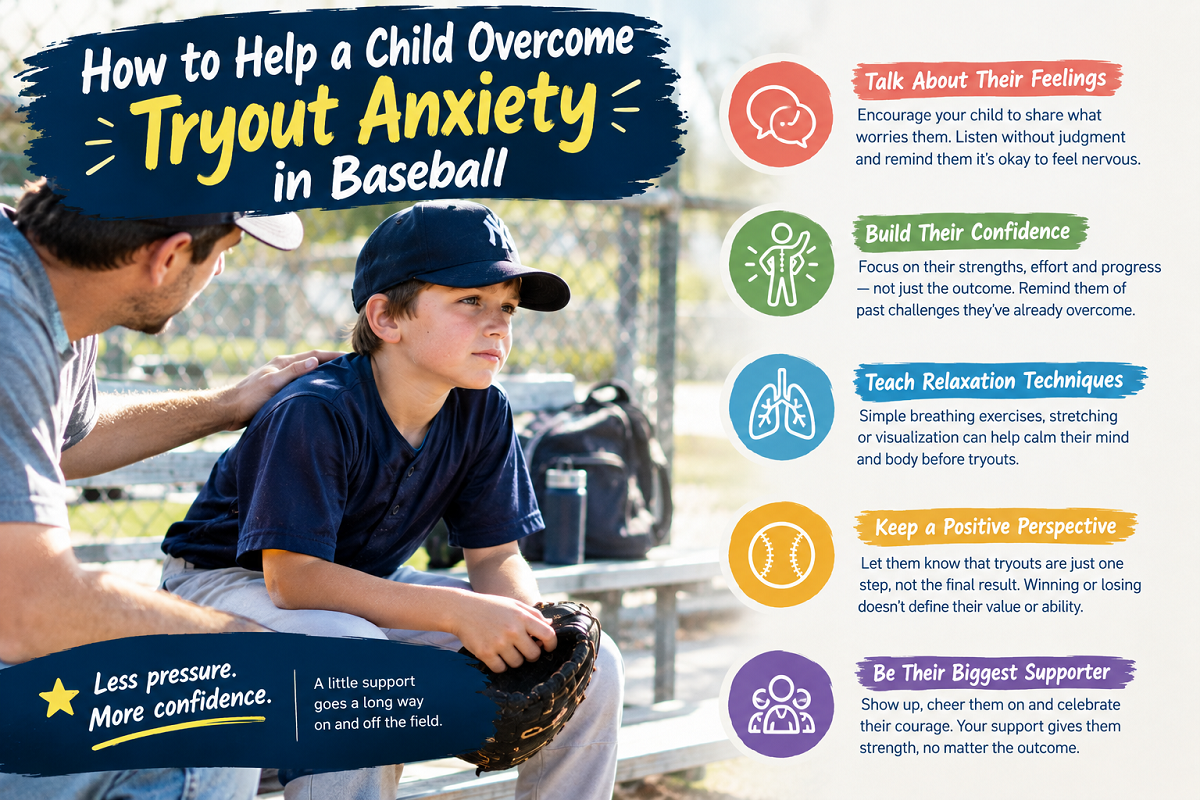
'I'm nervous' can mean several different things, and each needs a different response. Try one question, then listen without correcting: 'What part of tryouts feels the scariest?' If your child shrugs, offer options without leading: 'Some kids worry about messing up, some about who's watching, some about not knowing what to do. Does any of that sound like you?'
These are patterns, not findings from a single study, but each links to research above.
One clinical guide describes the difference this way. Validation says: 'I can see this feels really scary, and that makes sense.' Amplification says: 'Oh no, are you sure you're okay? You don't have to do it if it's too much.' The first tells a child their feeling is real and that they can handle it. The second tells them the situation is dangerous and that you're worried too. See Project Semicolon's guide. The next section explains why the second response, though loving, tends to backfire.
In child anxiety research, accommodation means changing what the family does to spare a child distress: allowing avoidance, giving repeated reassurance, or speaking for them. Summaries of work by Yale researcher Eli Lebowitz describe parental accommodation as a major factor in maintaining childhood anxiety, and clinicians generally explain that each act of avoidance teaches the brain the feared thing was dangerous. See Simply Psychology's overview and the APA training slides on caregiver accommodation.
In tryout terms, the trap looks like this: letting your child skip because they seem upset, promising 'you'll definitely make it' over and over, doing all the logistics so they never have to talk to a coach, or answering the same 'what if' question ten times.
The pattern clinicians recommend is to acknowledge the discomfort while showing confidence that your child can handle it. Texas Children's puts it as validating discomfort while demonstrating belief in the child's ability. Practically:
Gradual exposure means moving toward the feared situation in small, manageable steps, which is the approach clinicians favor over either forcing a child through or avoiding entirely. A sample ladder for tryouts follows. Your child chooses how fast to climb, and each rung is repeated until it feels easier.
| Rung | Step | What it trains |
|---|---|---|
| 1 | Visit the field when it's empty and play catch | Familiarity with the place |
| 2 | Take ground balls with one parent watching | Being observed by one person |
| 3 | Do a few reps with two or three friends watching | Being observed by peers |
| 4 | Run a mock tryout with stations and number stickers | The format and its pressure |
| 5 | Attend an open practice, clinic or scrimmage with the same league or coach, if offered | Meeting the real setting |
| 6 | The tryout | Applying it all |
If your child refuses at rung one or two, that is information. It may be a sign to bring in a professional rather than push harder.
A goal like 'make the team' depends on other kids, the coach's needs and how many spots exist. None of that is in your child's hands, which is the recipe for worry. Mastery-climate research (see the Smoll study above) points the other way: value effort and improvement, and anxiety tends to fall.
Coaching and youth-baseball sources are fairly consistent here, and the list is more reachable than most kids assume:
These are advice pieces from coaches and organizations, not controlled studies, and every program is different. If you can, ask the coordinator what the evaluators score.
Help your child pick three process goals and write them on a card. Examples: 'Hustle on and off the field every time.' 'Look the coach in the eye when they talk.' 'After a mistake, reset and get ready for the next one.' After the tryout, the question is 'Did you do your three things?' not 'Did you make it?'
There's no study on the perfect countdown, so treat this as a sensible structure built from the findings above. Starting earlier than the last few days is the one point Taylor stresses most.
Keep activity light and positive. Skip big mechanical changes, which tend to add self-doubt right when confidence is needed. Review the three-goal card. The night before, pack the bag together, serve a normal dinner and keep the evening routine ordinary. If sleep is poor, say that one rough night doesn't ruin a performance; worrying about sleep often makes it worse.
Arrive with enough time to check in, find the field, use the restroom and warm up without rushing. Coaches' guides commonly suggest getting there early, and it also gives an anxious child a calmer start. Offer a familiar breakfast and keep conversation light.
Choose two or three tools and practice them. Here is what's known about each, honestly.
What it is: breathing slowly, with the exhale longer than the inhale. One adolescent research protocol used exhales about twice as long as inhales, for example three seconds in and six out. See the clinical trial description.
What the evidence says: A high school feasibility pilot reports that slow diaphragmatic breathing has been linked in youth to lower in-the-moment anxiety, sport-related anxiety and test anxiety, though the pilot itself mainly showed the program was practical to run. See the Frontiers pilot paper. A 2026 scoping review of breathing techniques in 14 to 17-year-old athletes found reduced anxiety in the included studies but no consensus on the best technique, and only five eligible papers. See the scoping review. A small university student-athlete study found athletes said slow breathing helped them feel less nervous before games and refocus, though measured distress scores did not change significantly in its tiny sample. See the Bournemouth abstract.
Bottom line: promising and low-risk, but not a miracle. Teach it as one tool. Practice it daily for a couple of weeks at home, not only on the field. For young kids, 'smell the pizza, blow it cool' works as a script.
What it is: telling yourself 'I'm excited' instead of trying to force calm. Harvard's Alison Wood Brooks found in 2014 experiments that people who said they were excited before singing, public speaking or a math task performed better than those who said they were calm or anxious. The excited group didn't report less anxiety; they felt more excited and did better. Summaries: Medical News Today and Clearer Thinking.
Caveat: those participants were adults doing tasks like karaoke, not children at a baseball tryout, so it is a reasonable idea to test, not proven for kids. One way to use it: 'Your body's revving up. That's the same engine as excitement. Let's say it: I'm ready, I'm excited.' If your child finds it fake, drop it. Forcing it can feel dismissive.
Pick a small physical cue to mark 'last play is over': tapping the glove, adjusting the cap, touching the dirt. This is a common coaching practice rather than a studied intervention for tryouts, but it gives a nervous child something concrete to do with their hands and attention. Pair it with one slow exhale.
Give your child a short positive cue for each rep ('smooth,' 'low,' 'eyes'). Avoid cues built on 'don't,' which keep attention on the thing to avoid. This is practical coaching advice, not a research finding.
Return to the card: effort, attention and recovery. Between reps, kids are still being seen, so cheering on others, listening and picking up equipment all send the signals coaches say they value. A child who makes an error and still hustles is displaying exactly what the guides describe.
Research with youth athletes suggests they want parents present but not coaching. A review of what young athletes prefer, summarized in a recent blog post drawing on Knight and colleagues, finds they want praise and understanding rather than technical or outcome-focused feedback. Concretely: keep a calm face, give a thumbs-up if they look over, and don't shout instructions from the fence. If the tryout lets parents watch, stay back; if not, wait where you're told.
If your child wants you to leave, or stay, ask beforehand and respect the answer. Research on what athletes want from parents repeatedly emphasizes talking to the child about what works for them, as sports psychologist Camilla Knight stresses in an Inner Drive summary.
A study of parents in youth sport found that the stress parents perceive was positively associated with their own direct behavior and pressure on their children, and that parents of children at more competitive stages reported more stress, including fear of deselection. See the PMC study on parental stressors. In other words, your nerves are not a private matter. They are likely to leak.
Before the tryout, ask yourself honestly:
Psychologist Mary Ann Little makes a related point: parents should learn to regulate their own emotions about their child's performance, and their job is to remove pressure rather than add it. See her comments in Scary Mommy. A simple habit: talk through your worries with another adult, not your child, and use the same slow breathing you are teaching them.
A study of 73 young athletes and their parents looked at whether parents' goals (wanting a child to do well compared with others, or to avoid doing worse than others) related to anxiety in both parent and child. See the summary on Bulletproof Musician. Even without relying on that study's details, the question is worth asking: do your comments compare your child with others, or talk about their own progress?
Interviews with youth athletes by Camilla Knight and colleagues found that preferences differ by phase of competition (before, during, after), that athletes preferred comments about effort and attitude over technical critique, and that many just need space after a loss before they want to talk. See Knight, Neely and Holt (2011) and a summary of how kids want parents to behave. The same summary notes that kids enjoy their sport more when parents cheer for other children too. Harwood and Knight's work also suggests that parents who control their own emotions help their children enjoy competition more. See Inner Drive's roundup.
Say little. Keep a calm face. Thumbs-up if they look over. Cheer for other kids if the setting allows.
Start with something that has nothing to do with the result: 'I liked watching you.' Offer food and water. If your child wants space, give it. Ask open questions later, in a relaxed moment: 'What was the best part? What was the hardest part?' Then let your child talk first. Offer at most one suggestion, if asked, and finish with a strength.
| Helpful | Unhelpful |
|---|---|
| 'I'm proud of how you prepared.' | 'Why didn't you swing at that one?' |
| 'What were your three things? Did you do them?' | 'Did you see how good that other kid was?' |
| 'Tell me about it when you're ready.' | 'You looked nervous out there.' |
| 'I'll be there whatever happens.' | 'You'll probably get picked, don't worry.' |
The wait is often the hardest part for parents, and the research above suggests children read your mood. Plan ordinary activities, and decide in advance how you'll spend the day results come out. Before results, it is also worth preparing your child for the possibility of not making it, as sport psychologists recommend (see the next section).
Guidance on coping with deselection, summarized by Balance Is Better from sport-psychology research, suggests preparing your child for the possibility of not making the team. See Balance Is Better's summary. Sport psychologist John Murray likewise advises a realistic view of skills and the chance of not making it, and says a child should still feel accepted at home. See Murray's tips. A calm pre-tryout line: 'If it doesn't go the way you hope, we'll figure out the next step together.' This is different from expecting failure; it's removing the fear that the worst case would be unspeakable.
A study of 14 adolescent athletes who were cut from provincial teams and 14 of their parents found that athletes coped by lowering expectations beforehand, using positive self-talk and talking with parents, and that parents helped by consoling first and talking later. See the study abstract. The same research, explained for young readers, notes that athletes sometimes wanted to be left alone at first and that parents needed to be sensitive when the athlete did open up. See Frontiers for Young Minds.
In practice: 'I'm sorry. I know how much this mattered.' Then let your child cry, rant or go quiet. Skip the silver lining for now, and don't criticize the coach or your child's play.
The same Frontiers piece says athletes and parents recognized that being cut didn't have to mean leaving the sport and that other chances to play at a competitive level existed. Several parenting and sports sources suggest options such as another league, a school or rec team, or a skills program. One parenting article on cuts warns that a discouraged child often drops the sport entirely, so help your child find a way to keep playing if they still love it.
A USA Football parent-columnist suggests waiting a couple of days, then having the child ask what to work on to be considered next time, rather than a parent arguing the decision. See the USA Football blog. These are practical recommendations, not experimental findings, but they match the broader research on supporting a child's sense of control.
Sadness after a cut is normal. If it lasts for weeks, spreads into school and friendships, or your child says things like 'I'm worthless,' contact your pediatrician or a mental health professional. If your child talks about harming themselves, seek urgent help.
Tryouts combine several stressors: being watched, a short evaluation window, an unknown format and social stakes. Research on youth sport links parental and coach pressure to both mental and physical anxiety, and kids tend to pick up parents' anxiety through behavior. Understanding the specific fear helps.
Physical symptoms are a common part of anxiety, and studies link pressure to somatic (bodily) anxiety. If symptoms are intense, last for days or spread beyond baseball, talk to your pediatrician.
Clinical guidance warns that avoidance tends to keep anxiety going. A middle path is a small-steps ladder (see above) with your child choosing the pace, plus professional support if they cannot make progress. Don't force them, and don't automatically rescue them.
In Brooks' experiments with adults, saying 'I am excited' before singing, speaking or a math task improved performance compared with saying 'I am calm.' It hasn't been tested on kids at tryouts, so try it and drop it if it feels fake to your child.
The evidence in young people is encouraging but early. Reviews and pilots report reduced anxiety, but there is no agreed best technique and some small studies didn't show significant changes on measured scores. It is low-risk and worth practicing at home first.
Coaching and organization guides emphasize attitude, hustle, focus, coachability and sportsmanship alongside physical skills such as bat speed, arm strength and hand-eye coordination. They also say evaluators don't mind an occasional missed grounder or swing. Ask the league what its evaluators score.
Follow the league's rules and ask your child. Research on youth athletes' preferences points to calm, supportive presence and praise for effort rather than coaching from the sideline.
Start with something unrelated to the result, such as 'I liked watching you.' Give your child space if they need it, and ask open questions later. Research summaries note many athletes want a break before talking.
Console first, talk later. Research on deselection found that parents who listened and put things in perspective helped, and that athletes and families recognized other ways to keep playing. Wait a few days before asking about feedback or next steps.
Yes. Nerves aren't a measure of ability. Sport psychology treats some arousal as normal, and the practical goal is to channel it with skills like breathing, a reset routine and process goals.
The most useful finding across this research is also the least glamorous: the way the adults around a child behave affects their anxiety, and the adult behaviors that help are specific and learnable. Lower the pressure on outcomes. Reduce the unknown. Practice the tools early. Answer worries once, with confidence in your child. Stay calm in front of them. And decide in advance how you will respond if the answer is no.
If you do those things, tryout day stops being a verdict on your child and becomes what it really is: one chance to show what they can do, and one chance to learn that they can feel nervous and step onto the field anyway.

This post has been authored and published by one of our premium contributors, who are experts in their fields. They bring high-quality, well-researched content that adds significant value to our platform.