Softball Glove for Small Hands: 10-Year-Old Size Guide
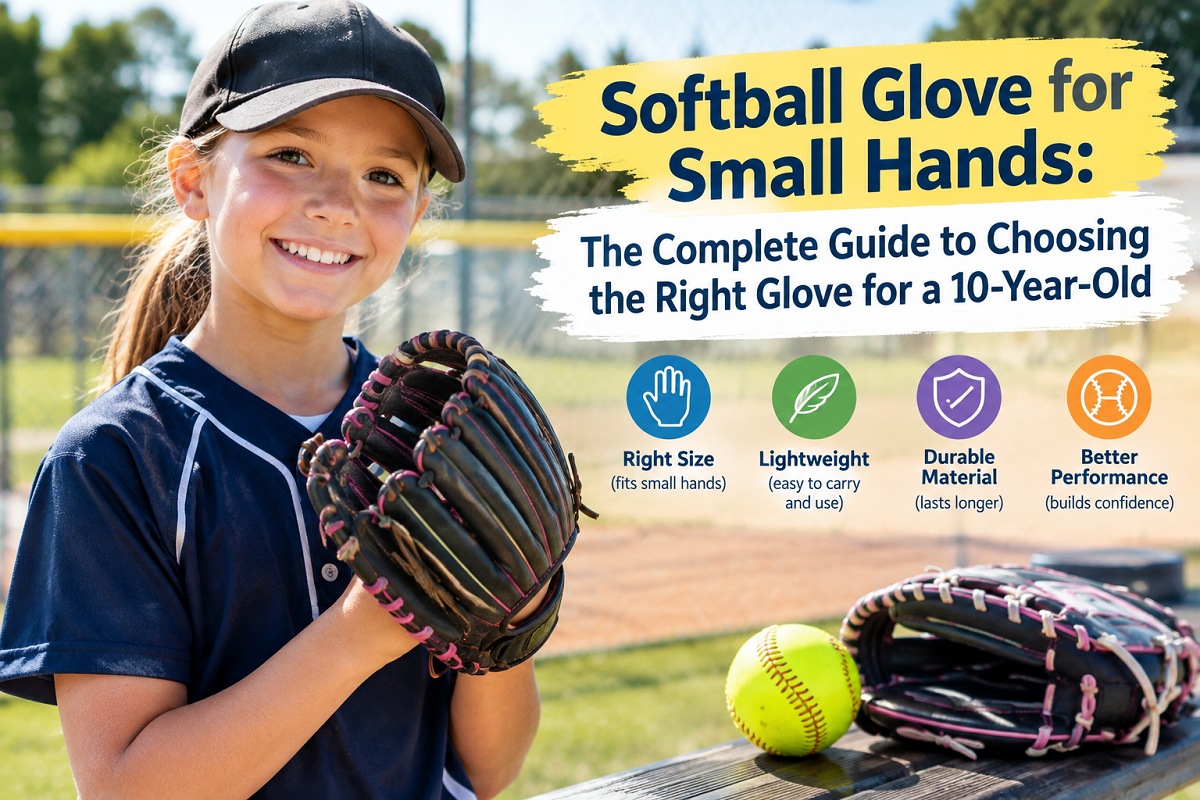
Most buying guides for a “good glove for a 10-year-old with small hands” give you a list of popular models and a vague age chart. They don’t explain why a glove that is “the right size on paper” still flops around, what to do when your daughter falls between sizes, or how to fix a glove that is too big.
This guide covers those gaps. You’ll learn how to measure a small hand, which 10U fastpitch glove size works by position, how to tell whether a glove fits, and how to make a softball glove smaller without ruining it. Everything here applies to both fastpitch and slowpitch players.
Table of Contents
- Why Softball Gloves for Small Hands Are Hard to Find
- How to Measure Your Daughter’s Hand for a Softball Glove
- Softball Glove Size by Age and Hand Size (10-Year-Old Chart)
- 10.5 vs 11 vs 11.5 Inch Softball Glove: Which Is Right?
- Best Softball Glove for a 10-Year-Old by Position
- Youth Softball Glove vs Baseball Glove: Does It Matter?
- Leather, Padding, and Weight: What Matters for Small Hands
- Webbing and Pocket Depth for Beginners
- Finger Stalls and Hand Opening: The Fit Details Most Guides Skip
- How to Tell If a Softball Glove Fits
- How to Make a Softball Glove Smaller
- How to Break In a Youth Softball Glove Fast
- Softball Glove for a Left-Handed Thrower
- How Much to Spend on a Youth Softball Glove
- Glove Brands and Lines to Look At
- Mistakes Parents Make Buying a First Glove
- Softball Glove Care and Storage
- FAQs
Why Softball Gloves for Small Hands Are Hard to Find
A 10-year-old’s hand might be the size of a typical 8-year-old’s or a 13-year-old’s. That is why “age 10 means an 11-inch glove” works for some girls and fails for others.
Stores also sort youth gloves mostly by length in inches and by age label, not by hand width or finger length. A girl with short, narrow fingers can end up in a glove that is technically the right length but has finger stalls built for a wider hand.
What a Too-Big Glove Does to a Young Player
A glove that doesn’t suit a small hand causes problems that look like skill issues:
- Late glove closing. She squeezes harder and longer to close the glove, so she’s slower to secure the ball.
- Balls popping out. Her fingertips don’t reach the end of the stalls, so the glove’s tips don’t move with her hand.
- Flinching. A heavy, loose glove makes a nervous player pull away from the ball.
- Two-handed habits. She uses her throwing hand to help close the glove, which slows every transfer.
- Sore hands. A glove that rotates on the hand rubs and stings.
If your daughter has started dropping easy catches, check the glove before blaming her.
Why “Growing Into It” Usually Backfires
Buying a glove one size up to last two seasons works for cleats, but a glove is a precision tool. A little extra finger length is fine. A glove that is too heavy, too stiff, or too wide at the hand opening is not. A good rule: the glove can be slightly generous in length, but the weight, wrist fit, and hand opening should suit her now.
How to Measure Your Daughter’s Hand for a Softball Glove
Age charts are only a starting point. This five-minute home method gives you better data.
Step 1: Measure Hand Length
Have her lay her glove hand flat with fingers together. Measure from the crease where the palm meets the wrist to the tip of the middle finger. Record it in inches.
Step 2: Measure Hand Width
Measure across the widest part of the palm, just under the knuckles of the four fingers, not including the thumb. A narrow hand in a wide glove has the same problem as a short hand in a long glove.
Step 3: Measure Finger Length Separately
Measure from the base of the index finger (where it meets the palm) to the fingertip. Girls with short fingers but an average palm often find the finger stalls too long even when the glove “fits” by number.
Step 4: Test Her Grip Strength
Have her squeeze a tennis ball with the glove hand, then try holding a softball. If a regular softball takes real effort to grip, she should look at a lighter, softer, pre-broken glove rather than a stiff one.
Step 5: Note Her Wrist Size
Look at how much room an adjustable wrist strap needs. A very small wrist can run out of strap range on adult-sized gloves, which leaves the glove loose.
How to Read the Numbers
These are rough ranges, and kids vary a lot. Many 10-year-old girls have a hand length somewhere around 5.5 to 6.5 inches. If hers is at the lower end, or her hand is narrow, you’re shopping for small hands, and the smaller sizes in the next chart apply. Use the chart as a starting point and confirm with a try-on.
Softball Glove Size by Age and Hand Size (10-Year-Old Chart)
Glove size is measured from the top of the index finger, down the palm side, to the heel of the glove. Brands measure slightly differently, so treat these as ranges.
| Hand Length (Wrist Crease to Middle Fingertip) | Likely Glove Size | Common Use |
| Under about 5.5 in | 10 – 10.5 in | First glove, infield |
| About 5.5 – 5.9 in | 10.5 – 11 in | Infield, utility |
| About 6.0 – 6.4 in | 11 – 11.5 in | Infield, outfield, utility |
| About 6.5 in and up | 11.5 – 12 in | Outfield, first base |
What This Means in Practice
- 10 to 10.5 inch: Good for very small hands or a first glove. Easy to control, light, and quick for transfers.
- 11 inch: The most common 10U infield size and a safe pick for many small-handed shortstops and second basemen.
- 11.5 inch: A solid all-around size for utility players or girls with average hands.
- 12 inch: Usually for outfielders with bigger hands. On a small hand, 12 inches is usually too much unless it’s a lightweight youth model.
Age-Based Sizing Is Only a Starting Point
If you’ve searched “softball glove size by age,” you’ve seen charts that put 9 to 11 year olds in an 11 to 12 inch range. Those charts are built from averages. A girl in the 10th percentile for hand size should aim lower in the range, even if she’s tall or strong.
10.5 vs 11 vs 11.5 Inch Softball Glove: Which Is Right?
Parents often get stuck between two sizes. Here is how to decide.
Choose 10.5 Inches If
- Her hand length is under about 5.7 inches
- She’s a first-time player or only plays recreationally
- She plays middle infield and wants fast transfers
- Gloves at 11 inches feel top-heavy when she holds her arm out
Choose 11 Inches If
- She’s between sizes and plays infield
- She has small hands but good grip strength
- She plays at 10U, where the ball is often the smaller 11-inch size, and wants a bit more catching area
- You want a glove that will last into 12U with proper care
Choose 11.5 Inches If
- She plays outfield or several positions
- Her hand is average or large for her age
- The glove is lightweight with a soft break-in
The Tie-Breaker
If she is between two sizes, pick the smaller glove for infield and the slightly larger glove for outfield. Control matters more than reach in the infield, and reach matters more in the outfield, but only if she can close the glove easily.
Best Softball Glove for a 10-Year-Old by Position
The position she plays changes what the glove has to do.
Infield Glove for Small Hands (Shortstop, Second, Third)
Infielders need quick transfers. A smaller glove, 10.5 to 11.5 inches, gets the ball out faster and is easier for a small hand to control.
- Web: Open webs such as an I-web or H-web are lighter and let dirt pass through. A closed web gives more support but adds weight.
- Pocket: Medium to shallow so the ball comes out quickly, but not so flat that line drives pop out.
- Weight: Lighter is better. A heavy glove slows every throw.
Softball Glove for Small Hands in the Outfield
Outfielders need reach, but a small-handed 10-year-old shouldn’t be forced into a stiff 12-inch glove.
- Size: 11.5 inches is a good target. Go to 12 only if the glove is soft and light and she can close it one-handed.
- Web: Basket or trapeze webs give a deeper pocket for fly balls.
- Break-in: Soft or pre-broken leather matters more than size.
First Base
First base mitts have a long, curved scoop shape. At 10U they can feel huge on a small hand. Look for a youth first base mitt, or use a regular 11.5 or 12 inch glove if the league allows it. Check league rules first.
Catcher
Catcher’s mitts are heavier and heavily padded. A small-handed 10-year-old needs a youth catcher’s mitt that is pre-broken and sized for her hand. Don’t buy up. A stiff mitt that’s too big hurts the hand and can make a young catcher afraid of the ball.
Pitcher
Pitchers usually use a closed web so the batter can’t see the grip. For small hands, an 11 to 11.5 inch glove with a closed web and light leather works well.
Utility Player or Beginner
If she plays several positions or is just starting, an 11 inch youth fastpitch glove in soft leather is the most forgiving first choice.
Youth Softball Glove vs Baseball Glove: Does It Matter?
This is one of the most searched questions, and the answers online are often too vague.
Why Softball Gloves Are Different
A softball is larger than a baseball. Fastpitch softballs are typically 11 or 12 inches around, while a baseball is about 9. Softball gloves are built with:
- A deeper, wider pocket to cradle the bigger ball
- More width across the palm
- A shape that suits the way a bigger ball bounces and arrives
A baseball glove has a shallower pocket. A hard-hit softball can pop out of it more easily.
Can She Use a Baseball Glove for Softball?
For backyard catch or a first practice, yes. For regular play, a softball glove is better. A small-hand infield baseball glove may fit her hand fine but will give her a smaller catching area and more bobbled balls.
Check Your League’s Ball Size
Many 10U fastpitch leagues use an 11-inch ball, and others use 12 inches. Slowpitch often uses 11 or 12 inches as well. Confirm your league’s ball size before you buy. An 11-inch ball often works well with an 11 inch glove, while a 12-inch ball benefits from a slightly deeper pocket.
Leather, Padding, and Weight: What Matters for Small Hands
For a small hand, how a glove feels in the first hour matters more than how it looks after a season.
Synthetic and Soft Leather
Entry-level youth gloves often use synthetic or soft, thin leather. For small hands this is an advantage:
- Lighter weight means less arm fatigue
- Easier to close right out of the box
- Often pre-broken so she can catch right away
The trade-off is lower durability and less shape retention.
Full-Grain Leather
Premium gloves use thicker full-grain leather. It lasts and forms a great pocket, but it’s heavy and stiff early on. A small-handed 10-year-old can struggle to close a stiff premium glove, especially one built for older players.
Pre-Oiled and Game-Ready Leather
Many youth models are sold “pre-oiled” or “game ready.” This helps small hands because she doesn’t need weeks of work to get the glove to close.
Padding
Padding at the heel and base of the fingers protects against stings. For a young player who is nervous about catching, extra padding in the palm helps build confidence. Too much padding adds weight, so look for a balance.
The Sweet Spot
For most 10-year-olds with small hands, a soft, mid-grade leather youth glove balances comfort, durability, and price. Look for descriptions like “soft,” “flexible,” “pre-broken,” or “easy close.”
Webbing and Pocket Depth for Beginners
Web Types in Plain English
- Closed webs (basket, closed trapeze): Solid catch area, good for pitchers and outfielders, slightly heavier.
- Open webs (I-web, H-web, cross web): Lighter and more flexible, popular for infielders because the transfer is quick.
- Modified trapeze: A common outfield web that works well in a shorter glove.
For a small-handed beginner, an H-web or modified web is a good starting point because it adds some give and reduces weight.
Pocket Depth
A deep pocket helps catch a large ball but is hard to work with if her fingers can’t reach the bottom. For small hands, choose a pocket she can close without using her other hand. Hold the glove out, open, and have her snap it shut. If she has to squeeze with effort, it’s too stiff or too deep for now.
How Pocket Placement Changes the Catch
On a glove for small hands, the pocket should sit close to the palm where her hand naturally contacts the ball. If the pocket is too far toward the fingertips, she’ll be catching with the end of the glove, which makes the glove feel unbalanced.
Finger Stalls and Hand Opening: The Fit Details Most Guides Skip
Most “best youth glove” lists never mention these, but they decide whether a glove actually feels right.
Finger Stalls Too Long
When her fingers don’t reach the ends of the stalls, the glove’s fingertips lag behind her hand. The result is a delayed close and a glove that feels floppy. This is the most common reason a “correctly sized” glove feels wrong.
Signs of finger stalls that are too long:
- Her fingertips stop a half-inch or more short of the end
- The glove folds in the middle instead of at the fingertips when she closes it
- She has to look at the glove to know where the ball is landing
Hand Opening Too Big
A loose hand opening lets the glove slide and rotate. A strap can help, but if the opening is much bigger than her hand, no strap fixes it.
Signs of a hand opening that is too large:
- The glove slides toward her fingers when she reaches
- You can fit extra fingers between her wrist and the glove edge
- The glove twists when she throws
Pinky and Ring Finger Stalls
Small-handed players often have trouble spreading the pinky and ring fingers far enough to fill wide-set stalls. Look for gloves described as “youth fit,” “narrow,” or “small hand design.” These are built with tighter stall spacing.
Why the Youth Label Matters More Than the Inch Number
Two gloves can both be 11 inches long. One is built on an adult pattern and the other on a youth pattern with narrower stalls and a smaller opening. For small hands, the youth pattern is usually the better fit even at the same length.
How to Tell If a Softball Glove Fits
If you’ve wondered how tight a softball glove should be or how to know if it’s too big, use this checklist.
Signs It Fits Well
- Her fingers reach the ends of the stalls with just a little room
- The glove doesn’t slide or rotate when she moves her arm
- She can close it one-handed around a ball
- The wrist strap snugs the glove without pinching
- She says it feels like part of her hand
Signs It’s Too Big
- Fingertips stop short of the stall ends
- She uses her other hand to help close it
- The ball pops out on easy throws
- The glove slides or turns on her hand
- The glove feels heavy after a few minutes of catch
Signs It’s Too Small
- Her fingers are jammed against the ends or her thumb has no room
- The strap leaves marks or causes pain
- She can’t fit her hand all the way in
The 6-Step In-Store Fit Test
- Put it on with the strap loose. Slide her hand in fully.
- Tighten the strap. Snug, not painful.
- Do the snap test. Open the glove, then have her snap it shut with one hand.
- Check the thumb and pinky. Both should move freely and sit in their stalls without pinching.
- Play catch. Ten to fifteen easy throws. Watch for bobbling or popping.
- Ground ball test. For infield gloves, roll a few balls and see whether she can scoop and close cleanly.
Buying Online
- Measure her hand first using the steps above
- Pick a store with free returns
- Read reviews that mention “small hands” or “narrow hands”
- Try the glove on indoors and avoid using it outside until you’re sure, because many retailers won’t accept returns on used gloves
How to Make a Softball Glove Smaller
If the glove is close but too big, try these fixes, starting with the simplest.
1. Tighten the Wrist Strap
Cinch the strap as snug as is comfortable. This brings the glove closer to the hand and reduces sliding.
2. Re-Lace or Re-Position the Strap
Some gloves let you re-route the strap or lacing to tighten the hand opening. A repair shop can do this quickly.
3. Fill the Finger Stalls
If her fingers don’t reach the ends, add a thin cotton pad or foam insert at the tip of the stall. Don’t overstuff. The goal is to move the fingertip contact closer to the end, not to jam the hand.
4. Wear a Batting Glove or Thin Liner
A batting glove inside the glove adds grip and takes up a little space. It also reduces sliding. Make sure it doesn’t make the glove too tight.
5. Use the Two-Fingers-in-the-Pinky-Stall Method
Many infielders at all levels put two fingers (the ring and pinky) in the pinky stall. It tightens the feel and shortens the effective glove length. Ask her coach before making it a habit, because it changes how the glove closes and can feel awkward at first.
6. Have a Shop Shorten or Tighten It
A glove repair shop can often shorten finger stalls, tighten the hand opening, or re-lace the glove. This is usually cheaper than replacing a glove that is otherwise in good shape.
When Repairs Aren’t Worth It
If the glove is too big and too stiff and too heavy, you’ll fight it all season. Replace it.
How to Break In a Youth Softball Glove Fast
A properly broken-in glove closes on its own and holds the ball. Here’s a safe way to get there.
A Simple Break-In Routine
- Apply a small amount of conditioner. One thin coat on the pocket and hinge points is enough.
- Flex it by hand. Open and close the glove 50 times a day, working the thumb and pinky edges.
- Play catch. Real use does the most. Ten to fifteen minutes of easy throws helps form the pocket.
- Use a glove mallet. Tap the pocket gently to deepen it.
- Store it with a ball in the pocket. Wrap a band or strap around the glove overnight so it holds its shape.
What to Avoid
- Microwaves, ovens, or hot cars. Heat dries and cracks leather.
- Soaking in water. The leather can dry stiff and brittle.
- Heavy oiling. Too much oil makes the glove heavy and mushy and can weaken the laces.
- Sitting or stepping on it. This can distort the shape.
Realistic Timeline
A soft, pre-broken youth glove may be game-ready in a few days. Stiffer leather typically takes two to four weeks of regular use. Small hands have less strength to open and close the glove, so be patient and don’t skip the daily flexing.
Helping a Small Hand Break In a Glove
Have your daughter help. Opening and closing the glove builds hand strength and teaches her how it moves. Using the glove for catch every day, even for five minutes, works better than a single long session.
Softball Glove for a Left-Handed Thrower
A left-handed thrower wears the glove on her right hand.
Reading the Glove Label
This is where parents get confused. Glove labels usually describe the throwing hand, not the glove hand:
- RHT (right-hand throw): Worn on the left hand, for right-handed throwers.
- LHT (left-hand throw): Worn on the right hand, for left-handed throwers.
Brands sometimes label this differently, so always check the product description to see which hand the glove fits.
Availability
Left-handed throwers have fewer choices, especially in small youth sizes. Order early in the season, and consider online shopping if local stores don’t carry what you need.
Fit Rules
Everything in this guide applies equally to lefties. The difference is choice, which makes measuring and having a good return policy more important.
How Much to Spend on a Youth Softball Glove
A glove for a 10-year-old doesn’t need to be expensive, but the cheapest one is rarely a good idea.
Price Ranges and What to Expect
| Price Range | What You Typically Get | Best For |
| Under $30 | Basic synthetic gloves, minimal padding | Backyard play, trying the sport |
| $30 – $60 | Youth-fit gloves, softer materials, decent padding | Most rec-league players |
| $60 – $120 | Better leather, better pocket shape, longer lifespan | Competitive or frequent players |
| $120 and up | Premium materials, pro-style patterns | Advanced players with strong hands |
Prices change by brand and season, so use this as a rough guide.
Where to Save and Where to Spend
- Spend on fit and flexibility. A well-fitted mid-priced glove beats an ill-fitting expensive one.
- Save on cosmetic extras. Custom colors and stitching don’t help her catch.
- Look at last season’s models. Retailers discount previous-year gloves and the performance is nearly the same.
Buying a Used Softball Glove
A used glove can be a smart buy because it’s already broken in. Check for:
- Cracked or dry leather
- Broken or loose laces
- A misshapen pocket
- A stretched hand opening
A well-cared-for used glove can fit a small hand better than a stiff new one.
Glove Brands and Lines to Look At
Specific models change every year, so focus on product lines that consistently serve young players. Confirm current sizes and specs on the brand’s site or in a store.
Entry-Level Youth Lines
Major brands make youth fastpitch gloves with softer leather and smaller hand openings. Examples you’ll often see include Rawlings’ youth fastpitch lines, Mizuno’s Prospect series, Wilson’s youth fastpitch A-series gloves, and Easton’s youth fastpitch gloves. These are typically lighter, easier to close, and priced for families.
Step-Up Models
If she’s serious and has outgrown a beginner glove, consider mid-tier gloves with better leather and a better-formed pocket. They cost more but can last multiple seasons.
Specialty Fastpitch Brands
Some smaller brands focus on fastpitch gloves and offer small sizes or custom options that suit narrow hands. These can solve a hard-to-fit problem, but make sure you can return or exchange.
How to Compare Two Gloves
When two gloves look similar, compare:
- Listed hand fit (youth, small, standard)
- Weight, if listed
- Leather type
- Break-in level
- Return policy
Mistakes Parents Make Buying a First Glove
Buying Too Big
A bigger glove doesn’t make a better fielder. If she can’t control it, it’s the wrong glove.
Ignoring Ball Size
Ask what ball your league uses and check that the glove’s pocket works with it.
Choosing the Stiffest “Best” Glove
Premium gloves are designed for stronger, older players. A small-handed 10-year-old usually does better in something softer.
Not Matching the Glove to the Position
An infield glove and an outfield glove are built differently. Match the glove to the position she plays most.
Overlooking the Strap
If the strap can’t tighten enough for a small wrist, the glove will always feel loose.
Over-Oiling
More oil doesn’t mean a faster break-in. It means a heavier, mushy glove.
Not Asking Her
She knows how the glove feels. If she says it’s heavy or loose, believe her.
Softball Glove Care and Storage
A well-cared-for glove can last several seasons and may even pass to a younger sibling.
After Every Game
- Wipe off dirt and moisture with a dry cloth
- Air dry it away from direct heat if it got wet
- Don’t leave it in a sealed bag or a hot car
Weekly
- Check the laces for wear
- Add a small amount of conditioner if the leather feels dry
Off-Season
- Store in a cool, dry place
- Put a ball in the pocket and wrap a band around it
- Don’t stack heavy items on top
Cleaning
Use a damp cloth and a mild leather cleaner. Avoid household cleaners and harsh chemicals.
Replacement Signs
Replace the glove when it no longer fits, the leather is cracked, the laces are failing, or the pocket has lost its shape.
FAQs
What size softball glove does a 10-year-old need?
Most 10-year-olds use an 11 to 11.5 inch glove. With small hands, 10.5 to 11 inches is often a better fit. Consider her position, hand measurements, and the ball size your league uses.
What is the best softball glove for a 10-year-old girl with small hands?
Look for a soft, lightweight youth fastpitch glove in the 10.5 to 11.5 inch range with narrow finger stalls and an adjustable wrist strap. Fit and flexibility matter more than brand.
Is an 11-inch glove too big for a 10-year-old?
Usually not. It’s the most common 10U infield size. It only becomes too big when her hand is very small, the glove is heavy and stiff, or the finger stalls are far too long.
What size glove should a 10U fastpitch player use?
Most 10U players use 10.5 to 11.5 inch gloves. Infielders often use 10.5 to 11, and outfielders 11 to 12 depending on hand size and strength.
Can a 10-year-old use a 12-inch glove?
Yes, usually an outfielder with larger hands. For a small-handed player, 12 inches is generally too large unless the glove is lightweight and soft.
How do I know if a softball glove is too big?
Signs include fingertips not reaching the stall ends, the glove sliding or twisting, trouble closing it one-handed, and frequent dropped balls on easy catches.
How tight should a softball glove be?
Snug but comfortable. Her fingers should reach the stalls, and the glove shouldn’t slide on her hand. If it causes pain or leaves deep marks, it’s too tight.
How do I make a softball glove smaller?
Tighten the wrist strap, add finger padding, wear a batting glove inside, or have a repair shop shorten the stalls or tighten the hand opening.
Is a baseball glove okay for softball?
It can work for casual play, but a softball glove has a deeper, wider pocket suited to the larger ball. For regular play, use a softball glove.
What is the difference between youth and adult softball gloves?
Youth gloves generally have smaller hand openings, narrower stalls, lighter weight, and softer leather. Adult gloves are bigger and stiffer.
How long does it take to break in a youth softball glove?
A soft or pre-broken glove can be ready in a few days. Stiffer leather usually takes two to four weeks of regular use.
What is the best beginner softball glove for a 10-year-old?
A soft, lightweight 10.5 to 11.5 inch youth glove with an adjustable strap. Avoid heavy, stiff, or overly expensive gloves for a first glove.
What is the best softball glove for a small-handed infielder?
A 10.5 to 11.5 inch glove with an open or modified web, a medium-to-shallow pocket, and a snug hand opening. Weight and flexibility matter more than brand.
What is the best softball glove for a small-handed outfielder?
An 11.5 inch glove with a basket or trapeze web and soft leather. Go to 12 inches only if the glove is light and she can close it easily.
Does my 10-year-old need a catcher’s mitt?
Only if she catches. Choose a youth catcher’s mitt that is lightly padded and pre-broken. A stiff, oversized mitt can hurt her hand and shake her confidence.
What hand does a left-handed thrower wear the glove on?
The right hand. Check the label carefully, because gloves are usually labeled by throwing hand: RHT is worn on the left hand, and LHT on the right.
How much should I spend on a glove for a 10-year-old?
Most players do well with a glove in the $40 to $90 range. Spend more only if she plays often or competitively and has outgrown a beginner glove.
Can my daughter share a glove with a teammate?
It’s better not to. A glove molds to one hand, and sharing changes the fit. If you must, use a soft glove and readjust the strap for each player.
When should I replace my daughter’s glove?
Replace it when it no longer fits, the leather is cracked, the laces are failing, the pocket has lost its shape, or she has outgrown the size.
Final Thoughts
The best softball glove for a 10-year-old with small hands is one that fits her hand, suits her position, and closes easily. Measure her hand, choose a soft youth glove in the 10.5 to 11.5 inch range, check the finger stalls and wrist strap, and break it in with regular catch. A glove she trusts helps her catch more, throw faster, and enjoy the game.

About Premium Author
This post has been authored and published by one of our premium contributors, who are experts in their fields. They bring high-quality, well-researched content that adds significant value to our platform.
Popular Categories
Stay Connected
Recent Posts